
Long-Haired German Shepherd Grooming Guide
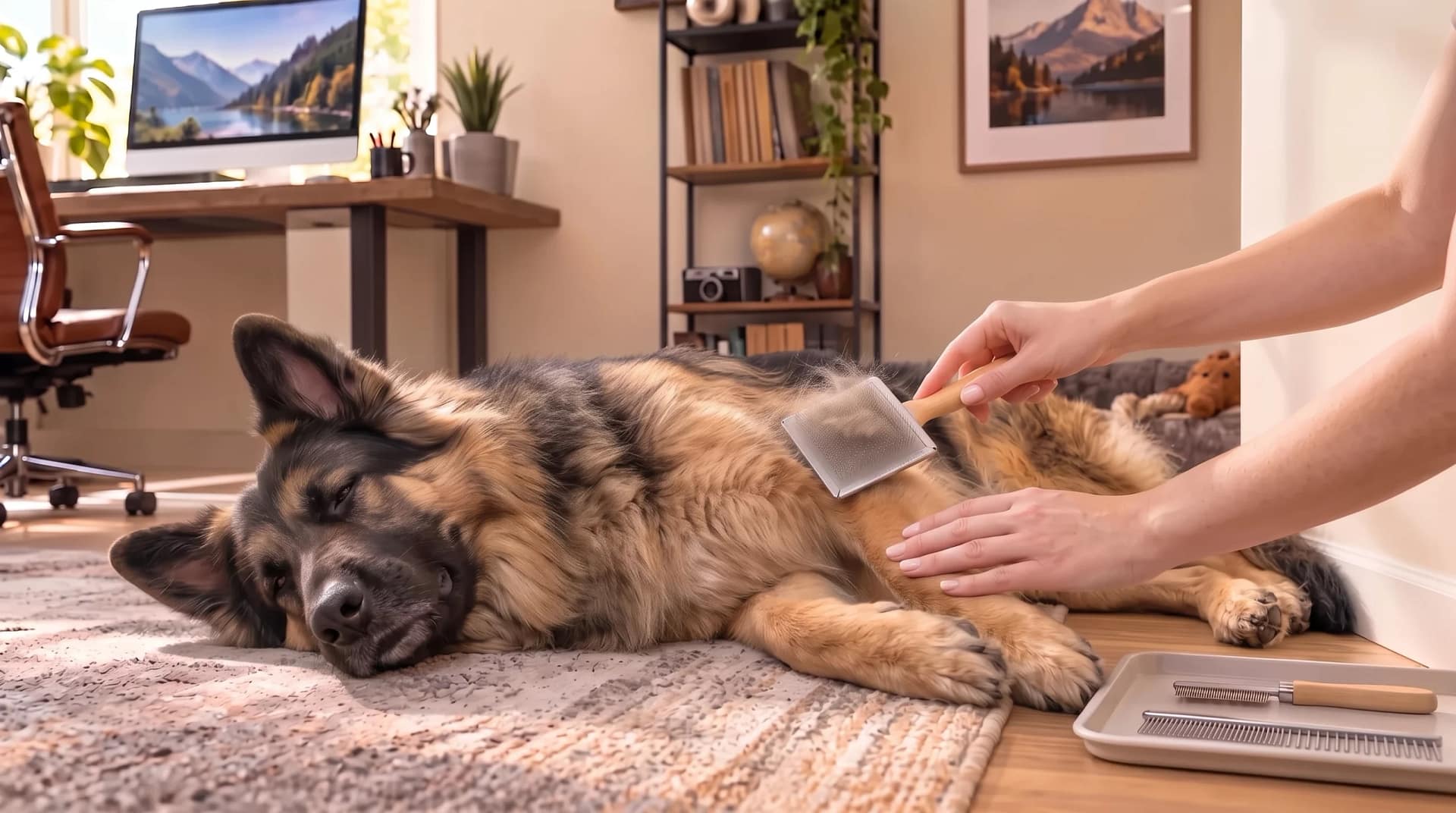
With a long-haired German Shepherd, grooming isn’t something you get around to when the coat starts looking rough. By then you’re usually dealing with mats. It’s part of looking after the dog, the same as feeding him and getting him out.
Mats behind the ears and fur drifting into every corner of the house come with this coat. Wet weather, mud, burrs, snow and seasonal shedding can all make it harder to manage. What your dog needs will depend on the coat, the season, where you live and what the two of you get into.
Everything here comes from grooming our own Shepherds at home. We’ve never taken them to a groomer for routine grooming, so this is what’s worked in our house, not necessarily how a professional would do it.
Grooming Is Not About Appearance
Appearance is the least of it. Grooming is usually the one time you go over the whole dog, section by section, with your hands. A long coat hides a lot. Weight can creep on or drop off without it showing, and plenty can sit under that coat for a while before anyone notices.
When you’re working through it regularly, you learn what’s normal for this dog. That’s what makes something new stand out.
Understanding the Double Coat
A long-haired German Shepherd has a double coat: a longer outer coat that takes the weather, and a dense undercoat underneath that insulates him and comes out in handfuls when the coat is changing.
The extra length also gives you more places for trouble to start. Behind the ears, the backs of the legs, under the collar and around the tail are usually where the coat tangles first.
Don’t routinely shave a German Shepherd’s double coat. The outer coat and undercoat have different protective functions, and shaving can interfere with normal coat regrowth. There are exceptions. Medical procedures may require clipping, and severe matting can sometimes make clipping the more humane option.
Take What the Dog Gives You
That’s the rule we go by. When Kai started, he’d give me about five minutes, and he’s worked up to around ten. If ten minutes is what he has for me that day, ten minutes is enough. Another dog might give you fifteen, or be perfectly happy lying there for half an hour. There’s no point stressing him because you decided before you started how long the session was supposed to last.
We groom on the floor, and the dog can stand, sit or lie down, whatever he’s comfortable with. Every Shepherd we’ve lived with has been different about it. Cheryl has always been particularly good with our dogs’ feet, and she can’t comfortably do Kai’s yet. That’s where we are with him right now.
If your dog doesn’t like being brushed, don’t assume stubbornness. Think about how he’s being handled, how much pressure you’re using and what grooming may have meant to him before he came to you. If he used to tolerate it and suddenly doesn’t, I’d also wonder whether something hurts.
Forcing your way through a frightened or struggling dog can make the next session harder. If there’s a real chance he’ll bite, that’s where I’d stop and get qualified help. Your veterinarian is a good place to start.
A Practical Grooming Routine
There isn’t one schedule that fits every long-haired German Shepherd. Coat density, weather, activity, shedding and the individual dog all matter. A dog that mats easily or spends a lot of time outdoors is going to need more attention than one whose coat stays clean.
What’s worked best for us is making grooming an ordinary part of the day rather than a big job every few weeks.
We’ve rarely had serious mats with our dogs, and I think regular brushing is a big reason why. You catch the little tangles before they have much chance to become something else. With a long-haired Shepherd, pay particular attention to the long feathering on the backs of the rear legs and that big Shepherd tail. There’s an awful lot of coat hiding in there. Run your hands through it as well as the brush—you’ll often feel a tangle before you can see it.
Daily or as needed
- check behind the ears, legs, collar line and tail
- remove debris and deal with damp areas
- deal with small tangles before they become mats
Regular full grooming
- brush through the coat
- remove loose undercoat without repeatedly scraping the skin
- check paws and nails
- use a comb to find tangles the brush missed
During heavier shedding
Increase the brushing and undercoat work as the individual coat requires. The calendar matters less than the dog standing in front of you.
You Don’t Need a Grooming Store in Your House
Spend a little time looking at grooming advice online and you’d think you need half a pet store before you’re allowed to brush a Shepherd. We don’t. What we actually use is pretty basic:
- a thinning brush for working through loose coat
- a regular brush
- a comb
- nail clippers
- a nail grinder
- a dryer
If you want to spend a gazillion dollars on grooming equipment, knock yourself out. We’ve never found it necessary. Knowing how to use what you have, and using it regularly, has mattered a lot more to us than anything we bought.
Bathing and Drying
We don’t bathe our Shepherds on a rigid schedule. They get a bath when they need one, and if nothing particularly filthy happens in between, roughly every six months has worked for us. Of course, sometimes the dog has other plans. Days at North 40 have resulted in more than a few unscheduled baths.
Before the bath, we work through tangles rather than discovering them once the coat is wet. We use a mild dog shampoo, and this is one place where I wouldn’t cheap out. You don’t need something fancy because the bottle has a picture of a German Shepherd on it, but use a decent shampoo made for dogs rather than whatever happens to be under the bathroom sink.
Rinse, then rinse again. With a long-haired Shepherd, shampoo can hide deep in that coat and undercoat long after you think you’ve got it all out, and residue left against the skin can irritate it. Work the water right down to the skin and through the whole coat, and don’t stop until you’re satisfied it’s all gone.
Our dogs have generally seemed to enjoy baths, although that doesn’t mean there hasn’t been some discussion or protest about getting into one. That’s Shepherd life. Once we’re actually underway, they’ve tended to settle into it and enjoy the attention.
With that much coat and undercoat, the dog needs to get properly dry. We use a dryer, and every Shepherd we’ve had has learned to love it. I think Bishop took the longest to come around, and even that was only a couple of times. Bishop was close to 100 pounds. If he decided he was moving, you weren’t going to hold him there anyway, so we didn’t. He learned what the dryer was and that nothing bad was happening, and before long it was simply another part of grooming.
That’s been our experience. Give the dog a chance to become familiar with the noise and sensation rather than assuming his first reaction is how he’ll always feel about it. Whatever dryer you use, follow its safety instructions and avoid excessive heat against the skin.
How to Brush
Work with the coat rather than dragging through it. Use enough pressure to reach the coat without scraping the skin, and don’t pull your way through resistance just because the brush stopped moving.
A comb is useful for checking the places most likely to tangle. If the dog has had enough, come back to it later.
When You Find a Mat
Don’t turn it into a wrestling match.
Small, loose tangles may be worked apart carefully. A tight mat sitting close to the skin is different. It can pull painfully on the skin, and it can pull the skin up into the mat with it, so trying to cut one out with scissors can injure the dog when you can’t clearly see where the mat ends and the skin begins.
We’ve used scissors on mats ourselves in the past, very carefully. Knowing what I know now, I wouldn’t recommend it to somebody else. If I couldn’t work a mat apart comfortably and safely, I’d stop. A qualified groomer or veterinarian can help decide whether clipping is the safer option.
Losing a patch of coat is a much smaller problem than cutting the dog or teaching him to dread the comb.
When Grooming Tells You Something Is Wrong
Pay attention to new lumps, ticks, redness, sores, odour, persistent itching, unusual hair loss, swelling, tenderness or a sudden change in how your dog responds to being touched.
Finding something doesn’t tell you what it is. It tells you you’ve found something worth paying attention to.
If a change is persistent, painful, worsening or otherwise concerns you, talk to your veterinarian rather than trying to solve a medical problem with another grooming tool.
You Learn Each Other
Grooming a Shepherd is a lot like living with a Shepherd. You learn each other. Over time you learn how this dog works: what he likes and doesn’t, what he’ll tolerate, his tendencies and how he tells you he’s had enough. While you’re figuring him out, he’s learning you too.
That’s one of the things I’ve enjoyed most about living with these dogs, how the communication changes as you get to know each other. I don’t know how it is with other dogs. I know how it’s been with us.
Where to Go Next
Grooming is only one part of everyday care. Continue with Care for a Rescued Long-Haired German Shepherd for the wider care picture and the next practical steps.
This guide provides general information about grooming and everyday care. It isn’t veterinary advice and can’t diagnose skin, coat, pain or other health problems in an individual dog. If something has changed or concerns you, speak with your veterinarian.