
The Shepherd Mind
Before You Explain the Behaviour, Look at What Happened
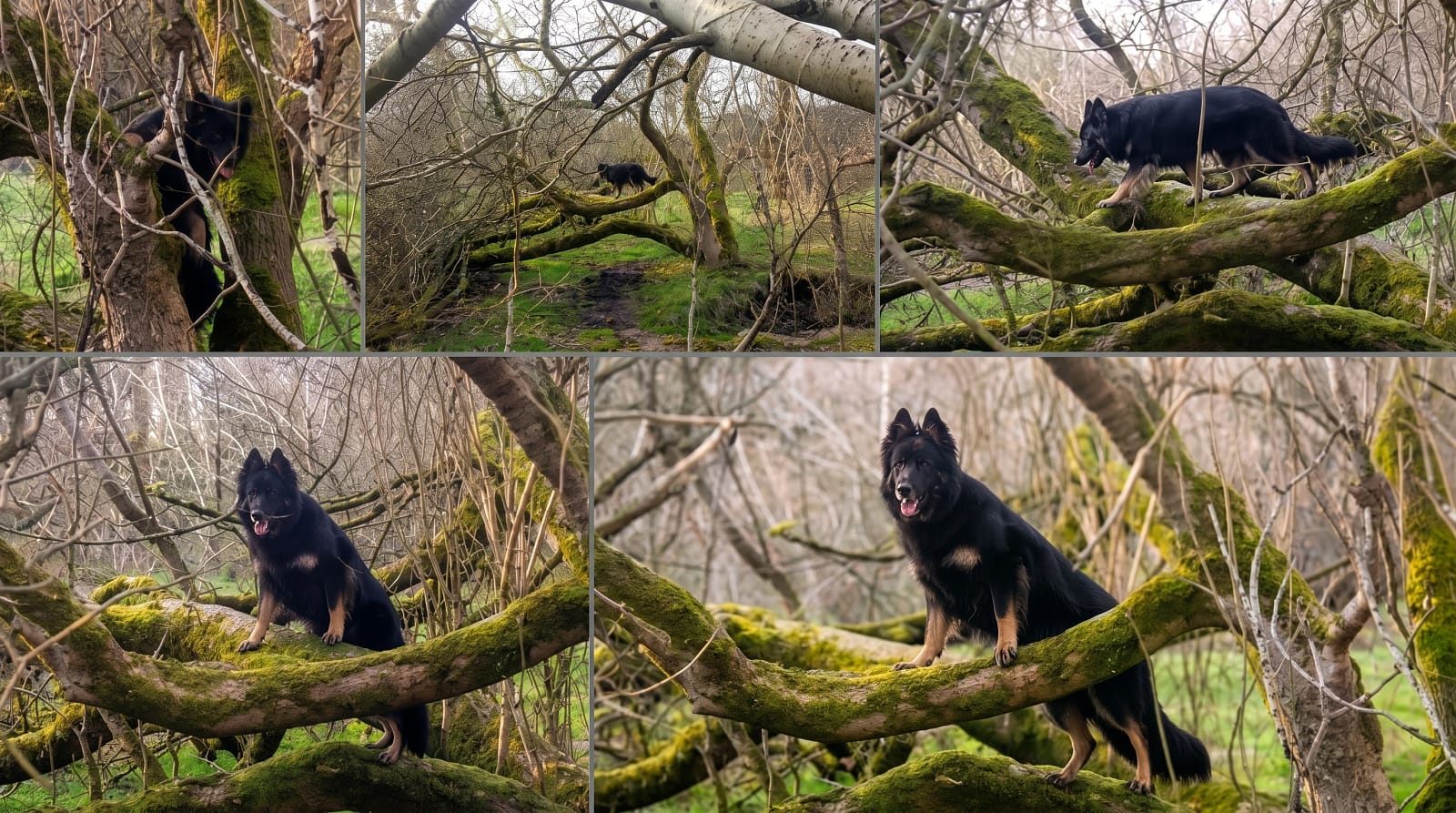
Start with what you can actually see
One Frame Gives You a Moment. The Sequence Gives You Context.
Those five photographs are Tia moving through the same tree.
One photograph gives me a moment. The sequence gives me more context. Neither tells me what Tia was thinking.
I knew Tia. I lived with her for years, and I knew her habits, her tendencies and how she responded to a lot of what went on around her. So of course I know more about what I’m looking at than somebody seeing one photograph of her for the first time. But I can still get it wrong, and that’s the idea behind The Shepherd Mind.
Before deciding a German Shepherd is stubborn, dominant, anxious, protective, defiant or doing half the other things humans confidently announce after watching a dog for thirty seconds, start with what actually happened.
Sometimes the explanation becomes fairly clear. Other times you need more information, and there are times I simply don’t know yet. I’d rather say that than invent a story because it sounds convincing.
Describe It Before You Explain It
A dog can stop moving, stare, bark, pace, pull, follow you through the house, turn away, refuse to move forward or get up every time somebody crosses the room. I can describe every one of those things without knowing why the dog did it.
That’s where I want to start.
The moment I say the dog is being stubborn, dominant, jealous, protective, defiant or manipulative, I’ve moved from describing behaviour to explaining it. Maybe I’m right. But now the explanation has to hold up against everything else I know about the dog and what was happening at the time.
- What happened immediately before it?
- Where were we?
- Who or what was nearby?
- What did the rest of the dog’s body look like?
- Could the dog disengage?
- What happened afterward?
- Has this happened before?
I’d also want to know whether anything has changed in the household, routine or the dog’s health.
Veterinary behaviour assessment covers much of the same ground, looking at behavioural history and context, including how often a behaviour happens and whether the pattern has changed.
None of that means standing around collecting observations while something dangerous happens. If there’s a safety problem, manage it. Create distance, prevent another incident and get qualified help when that’s what the situation requires. Deal with the real problem first, and be careful about claiming a cause you haven’t established.
Research: Merck Veterinary Manual — Diagnosis of Behavior Problems in Animals.
Context Changes What You Think You Saw
Suppose your dog stands and watches somebody. The watching is real; you can see it. Calling it guarding or protecting is an interpretation.
Maybe that’s where the rest of what you see eventually takes you. But I’d want to know about distance, posture, movement, the environment, what happened immediately before it and what the dog did next.
Or suppose you ask your Shepherd to do something and he pauses. You saw the pause, but you haven’t yet established that he’s challenging you.
The cue might not have been clear, something else could have caught his attention or the environment may have changed. He could be uncomfortable. He may have learned that waiting produces something useful. Or he’s just a German Shepherd and there’s a negotiation underway. There are possibilities I haven’t listed, too.
That’s why labels need some care.
Stubborn. Dominant. Reactive. Difficult. Protective. Too much.
Those words aren’t automatically useless. Sometimes they help us communicate quickly about what we’re dealing with. The trouble starts when the label becomes the explanation.
Dominance is a good example. The American Veterinary Society of Animal Behavior has warned against using dominance theory as a general explanation for unwanted behaviour. That’s different from claiming dominance relationships never exist between animals.
Calling a dog dominant just doesn’t explain every refusal, jump, growl, stolen sandwich or disagreement with a human.
For me, the useful question is simpler: What is the dog doing, what’s happening around him, and what do I want him to learn instead?
Research: American Veterinary Society of Animal Behavior — Position Statement on Dominance.
Behaviour still has a body attached to it
Behaviour Still Has a Body Attached to It
There’s another reason I don’t like explaining behaviour too quickly. Sometimes something hurts.
Pain and physical discomfort can show up through changes in movement, posture, activity, rest, tolerance of handling, social behaviour and ordinary routines.
A dog who suddenly becomes reluctant to move, restless, withdrawn, irritable or simply different from his normal self deserves a health question alongside the behaviour question.
That doesn’t mean every unusual behaviour has a medical cause. It means I don’t want to spend three weeks trying to train away something that started because the dog is uncomfortable.
If you’ve lived with your dog for a while, you know his normal better than somebody seeing him for the first time. If something changes suddenly—particularly alongside pain, altered mobility, appetite changes, unusual fatigue, sleep disruption or another physical sign—pay attention to that change and involve your veterinarian.
Research: AAHA — Common Pet Pain Signs.
With a Rescue Dog, Some of the Story Is Missing
This matters even more with rescue dogs because sometimes we simply don’t know what happened before they arrived.
I won’t turn every hesitation into abuse. I won’t turn every bark into trauma. And I won’t turn every reluctance into evidence of some terrible history I can’t actually document.
Could a dog’s previous life matter enormously? Of course.
But a newly adopted dog is also dealing with a new house, new people, different routines, unfamiliar animals, different expectations and situations we may know nothing about.
Those things are happening now. I can observe them.
The undocumented story somebody has constructed about what happened three years ago is something else.
If the history is missing, I treat it as missing. Then I pay attention to the dog who’s here.
Understanding the Dog Doesn’t Mean the Dog Runs the House
There’s an opposite mistake we can make here.
Trying to understand behaviour doesn’t mean handing the keys to the dog and hoping everybody reaches a democratic agreement by dinner.
I train my dogs. I use boundaries. And with a large, powerful German Shepherd, I want communication the dog understands and humans capable of managing the situation when something matters.
The order matters to me.
I want to understand what I’m looking at before I start insisting on a response without asking why I’m not getting one.
The answer might be giving the dog more space or changing something in the environment. Other times it’s clearer training, or simply preventing access to something while we work on the problem. And there are times when the answer is no, and I mean no.
Respecting the dog and training the dog aren’t opposites.
AVSAB recommends reward-based methods for dog training and behaviour modification and includes management as part of behaviour plans. That’s a useful professional boundary for the approach we take here.
Research: AVSAB — Humane Dog Training Position Statement.
You Learn the Dog in Front of You
The point isn’t to become afraid of interpreting your dog.
You live with him.
Over time you learn his patterns and habits, what gets his attention, what bothers him, what he enjoys, what he avoids and how he responds when something changes.
He’s learning you at the same time.
That’s part of living with these dogs, and I wouldn’t want to lose it by pretending we’re incapable of understanding anything unless somebody has published a paper about it.
The Shepherd Mind is something simpler.
Leave enough room between what I saw and what I think it means to make sure the explanation actually fits the dog in front of me.
Sometimes it will, and sometimes more information changes it. And sometimes the most accurate answer is still: I don’t know yet.
I’m perfectly comfortable with that.
Because Love Doesn’t Quit.