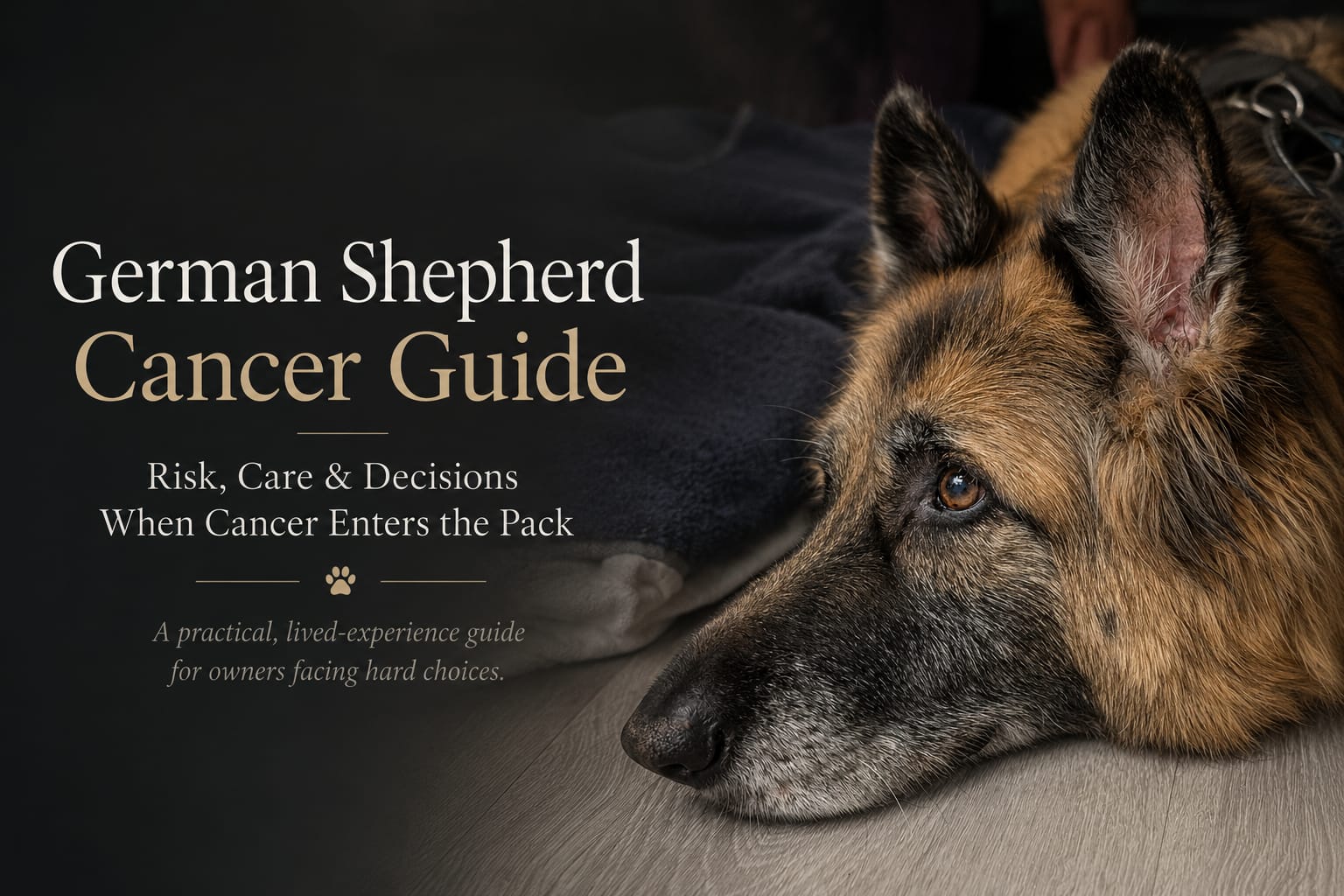
German Shepherd Cancer Guide: Risk, Care & Decisions
What Hits Them, How It Shows, and What Every Shepherd Owner Needs to Know
This German Shepherd cancer guide is a clear, honest starting point for understanding cancer risk, early signs, diagnosis, treatment options, and quality-of-life decisions in this breed.
If you live long enough with a German Shepherd, especially a long-haired German Shepherd, cancer may become part of the story.
Not every dog. Not every home. But often enough that ignoring it does not make sense.
Cancer does not ask if your dog is strong, brave, or deeply loved.
It comes anyway.
And in German Shepherds, it comes far too often.
This guide exists to help you understand what to watch for, which cancers commonly affect the breed, how decisions unfold, and why early veterinary involvement matters.
No panic. No false comfort. No medical theatre.
Just clarity early enough to matter.
This is not veterinary advice. If your dog is showing symptoms, declining, or something simply feels off, involve your veterinarian early.
This is not theoretical for us. We have lived through multiple cancer diagnoses in our own dogs — Tia, Bishop, and Mia — and each one changed how we saw the next.
Each cancer was different. Each decision was different. Each one dismantled the comfortable myth that love gives you control.
It does not.
But love can keep you steady enough to pay attention.
Why German Shepherd Cancer Matters
German Shepherds are powerful, intelligent, deeply loyal dogs.
They are also part of a breed with elevated risk for several serious cancers, including aggressive conditions such as hemangiosarcoma and osteosarcoma.
A long coat does not change genetic reality.
That matters because some owners assume long-haired German Shepherds are somehow a softer or separate version of the breed.
They are not.
They carry the same breed realities under more coat.
That does not mean your dog will develop cancer. It means awareness matters.
That awareness becomes especially important as your dog moves into middle age and beyond — often around seven years and older, though some conditions can appear earlier.
Because changes can be subtle.
And when something does develop, it can move faster than expected.
Understanding what normal looks like for your dog is one of the most important things you can do.
Not internet-normal.
Your dog’s normal.
The way they rise. The way they eat. The way they patrol the yard. The way they greet you. The way they hesitate before stairs. The way they suddenly stop doing something they have done for years.
German Shepherds compensate.
When signs show clearly, time may already matter.
Why Cancer Signs Can Be Subtle in German Shepherds
Cancer rarely announces itself clearly in the beginning.
It often starts with something small.
A limp that does not quite make sense.
A shift in energy you cannot explain.
A lump that feels like it probably is not anything.
Sometimes it is not.
Sometimes it is.
By the time something is clearly wrong, it may have already been developing for a while.
This is not meant to create fear.
It is meant to create awareness.
Because awareness changes how quickly you act.
And with German Shepherds, subtle changes matter more than dramatic ones.
They can hide discomfort. They can keep moving. They can keep working the room, watching the door, following you from place to place, and still be carrying something serious.
Strength can hide decline.
That is one of the cruel tricks with this breed.
Early Signs of Cancer in German Shepherds
Not every change means cancer.
But some changes should never be ignored.
- Persistent or unexplained limping
- Swelling that does not resolve
- New lumps or changing masses
- Sudden drop in energy
- Fatigue that feels different
- Loss of appetite
- Weight loss
- Difficulty breathing
- Collapse or weakness
- Pale gums
- Abdominal swelling
- Changes in bathroom habits
- Pain responses that were not there before
- Behaviour changes
- Withdrawal from normal routines
If something feels off, trust that instinct.
Your job is not diagnosis.
Your job is calm verification.
That means noticing the change, documenting what you see, and involving your veterinarian before the situation becomes obvious to everyone else.
With German Shepherds, “obvious” can arrive late.
Do not wait for dramatic proof.
Common Types of Cancer in German Shepherds
German Shepherds can develop many types of cancer, but several deserve special attention because of how often they appear, how aggressively they can behave, or how easily early signs can be missed.
Osteosarcoma
Osteosarcoma is an aggressive bone cancer often seen in large-breed dogs. It commonly affects the limbs and may first appear as limping, swelling, pain, or reluctance to bear weight.
Do not ignore persistent lameness in a German Shepherd, especially if rest does not improve it.
Hemangiosarcoma
Hemangiosarcoma is one of the most frightening cancers because it can develop internally and remain quiet until a crisis occurs.
It may involve organs such as the spleen or heart and can sometimes present suddenly through weakness, collapse, pale gums, abdominal swelling, or unexplained lethargy.
Sudden collapse, pale gums, or extreme weakness in a German Shepherd should be treated as a veterinary emergency, not a next-day appointment.
This is one reason hemangiosarcoma is particularly dangerous — the first clear sign can be a crisis.
Lymphoma
Lymphoma affects the lymphatic system and may show through enlarged lymph nodes, appetite changes, weight loss, lethargy, or general decline.
Some forms respond to treatment better than others, which is why diagnosis and staging matter.
Mast Cell Tumours
Mast cell tumours can appear on the skin or internally. They are highly variable. Some are less aggressive. Others are serious.
Any new lump, changing lump, or irritated mass should be checked by a veterinarian.
Guessing by appearance is not enough.
Anal Sac Adenocarcinoma
Anal sac adenocarcinoma is less commonly discussed but can be serious and easy to miss early.
Changes in bowel habits, scooting, discomfort, swelling near the rectal area, or unusual straining should not be brushed aside.
Mammary Tumours
Mammary tumours are more common in unspayed females and can vary from benign to malignant.
Any lump along the mammary chain should be examined promptly because early detection and veterinary assessment can change the options available.
Waiting to “see what happens” is not a plan.
If you are raising or caring for a long-haired German Shepherd, understanding these risks early changes how you respond.
This German Shepherd cancer guide is the starting point. Each condition deserves a deeper look.
Early Detection and What You Can Do
You cannot prevent every cancer.
That is the truth.
But you can improve the odds of catching problems earlier by knowing your dog, keeping regular veterinary care in place, and not dismissing persistent changes.
For German Shepherd owners, early detection starts with ordinary attention:
- Keep up with regular wellness exams.
- Know your dog’s normal weight, appetite, energy, movement, and behaviour.
- Check new lumps, changing lumps, swelling, or unexplained pain promptly.
- Pay attention to body condition, especially in middle age and senior years.
- Track changes instead of relying on memory when something feels off.
- Ask your veterinarian about breed risk, screening, and what matters for your dog’s age and history.
Spay and neuter timing can also be part of a larger cancer-risk conversation, especially in large breeds. That does not belong in internet shouting matches. It belongs in a thoughtful discussion with your veterinarian, based on your dog’s health, age, sex, structure, and risk profile.
Early detection is not paranoia.
It is responsible ownership.
There is a difference.
Diagnosis, Testing, and Staging
A cancer diagnosis is rarely just one simple moment.
Your veterinarian may need to confirm what is happening, identify the type of cancer, understand how advanced it is, and decide which options are realistic for your dog.
Depending on the symptoms and suspected cancer, diagnostics may include bloodwork, X-rays, ultrasound, fine needle aspiration, biopsy, advanced imaging, or referral to a veterinary oncologist.
Staging means looking at how far the disease has progressed and whether it has spread. That information matters because it can change the treatment plan, the expected outcome, and the quality-of-life conversation.
This is why guessing from symptoms alone is not enough.
The goal is not to collect tests for the sake of testing.
The goal is to understand what your dog is facing clearly enough to make the next decision responsibly.
When You Hear the Word “Cancer”
A German Shepherd cancer diagnosis is not just a medical moment.
It is the second after the word is spoken — when the veterinarian keeps explaining, the room keeps moving, and your brain quietly disconnects from reality.
That is when cancer really arrives.
Not as a disease.
As a fracture.
Your dog is still right there. Still breathing. Still leaning into you. And suddenly, you are terrified of getting it wrong.
If you are facing this right now, you do not need to become an expert in one afternoon.
You need steadiness.
You need space.
You need enough clarity to ask the next right question.
That is different from trying to solve the entire future before dinner.
The internet will happily hand you a shovel and point you toward a hole. Do not climb in yet.
Start with your dog. Start with your veterinarian. Start with facts.
The First 72 Hours After Diagnosis
The first few days after a cancer diagnosis are often the hardest mentally.
Not because everything has to be decided immediately, but because it feels like everything does.
- Shock
- Information overload
- Fear of choosing wrong
- Pressure to act quickly
- Conflicting advice from people who mean well
- Late-night searches that make everything worse
Very few cancer decisions must be made the same day.
Some emergencies are immediate. Collapse, uncontrolled bleeding, severe pain, breathing distress, pale gums, or sudden extreme weakness need urgent veterinary care.
But many decisions can be made after you have gathered information, asked questions, and had time to think clearly.
You are allowed to go home.
You are allowed to sit with your dog.
You are allowed to breathe.
Clarity comes after stabilization.
What Not to Do First
- Do not Google survival rates at midnight.
- Do not drown yourself in unmoderated forums.
- Do not compare your dog to strangers online.
- Do not let fear make every option sound urgent.
- Do not mistake more information for better clarity.
Statistics are averages.
Your dog is not.
Panic is loud.
Clarity is quiet.
What to Ask Your Veterinarian
- What do we know for certain?
- What still needs confirmation?
- What diagnostics are recommended next?
- Is this painful?
- Is this urgent or can we take time to decide?
- What are the treatment options?
- What are the comfort-focused options?
- Would a veterinary oncologist referral help?
- What changes should I watch for at home?
- When should I call immediately?
Those questions matter because they pull the conversation back from fear into decision-making.
And decision-making is where you can still help your dog.
The Emotional Reality of a German Shepherd Cancer Diagnosis
Cancer is not just a diagnosis.
It is waiting.
It is second-guessing.
It is trying to balance hope with reality.
It is watching your dog closely and wondering if you are doing the right thing.
It is learning that love can make you brave, but it can also make you bargain with facts.
That is why you need people around you who will tell the truth kindly.
You need a veterinarian you trust.
You need clear information.
You need to watch your dog more than you watch the calendar.
There is no perfect path.
Only informed decisions made with care.
Support vs Treatment
Whether your dog is waiting for a diagnosis, going through treatment, or in palliative care, the role of daily support changes — but it always matters alongside medical care.
There is a difference between helping your dog feel better and treating a condition.
Support means adjusting daily life to reduce strain and improve comfort.
Treatment means diagnosis, medical decisions, and veterinary care.
Both matter.
Comfort matters. So does knowing what you are actually dealing with.
Support may include changes such as:
- shorter walks
- better traction on floors
- ramps or step support
- softer bedding
- reduced jumping
- careful weight management
- pain management through your veterinarian
- quiet routines
- less environmental stress
Those changes can help.
If the dog is declining, limping, collapsing, bleeding, losing weight, or showing pain, you need veterinary guidance.
Blankets and hope are not a treatment plan.
Treatment Options for German Shepherd Cancer
German Shepherd cancer treatment depends on the type of cancer, location, stage, pain level, age, overall health, and what your dog can realistically tolerate.
Common options may include:
- Surgery
- Chemotherapy
- Radiation
- Palliative care
- Pain management
- Supportive care
- Referral to a veterinary oncologist
These are not interchangeable menu items. Suitability depends on diagnosis, staging, your dog’s condition, and veterinary guidance.
There is no universal correct choice.
There is informed choice.
For one dog, treatment may offer meaningful time and good quality of life.
For another, aggressive treatment may create more suffering than benefit.
That is the part people do not like saying out loud.
But it matters.
The goal is not to prove how much you love your dog by doing the most.
The goal is to protect your dog from unnecessary suffering while making the best decision you can with the information available.
That is harder.
And more honest.
Quality of Life Is the North Star
When cancer enters the picture, quality of life becomes the centre of every decision.
Not guilt.
Not fear.
Not what someone online says they would do with a dog they have never met.
Your dog’s comfort matters most.
Useful questions include:
- Is my dog comfortable?
- Is pain being managed?
- Can my dog rest?
- Can my dog move without distress?
- Is my dog still interested in food, people, routines, or small joys?
- Does this treatment reduce suffering or add to it?
- Are we buying good time or just more time?
- Can I live with this decision later?
Then comes the hardest question:
Are they still living?
Not simply breathing.
Living.
Still present. Still comfortable. Still able to be themselves in some meaningful way.
Choosing comfort is not quitting.
It is protection.
And sometimes protection is the last job love gives you.
When You Know It Is Time
This is the hardest part.
Sometimes it is pain that cannot be managed.
Sometimes it is loss of mobility.
Sometimes it is collapse, distress, or a sudden decline.
Sometimes it is a change in your dog that tells you something is not right anymore.
You do not make that decision alone.
Work with your veterinarian. Ask the hard questions. Be honest about what you are seeing at home.
Dogs do not need us to win against cancer at any cost.
They need us to stay loyal to their welfare.
Even when that loyalty breaks us.
German Shepherd Cancer Guide FAQ
Is cancer common in German Shepherds?
German Shepherds are among the breeds where several serious cancers deserve close attention, including osteosarcoma and hemangiosarcoma. That does not mean every German Shepherd will develop cancer, but it does mean owners should take unexplained changes seriously.
What are common German Shepherd cancer signs?
Common German Shepherd cancer signs can include persistent limping, new lumps, swelling, weight loss, appetite changes, pale gums, collapse, breathing difficulty, or behaviour changes. None of these signs automatically mean cancer, but they do deserve veterinary attention.
What are common German Shepherd cancer symptoms?
German Shepherd cancer symptoms may be subtle at first. Watch for changes in movement, energy, appetite, weight, breathing, bathroom habits, comfort, or normal routines. Persistent changes matter more than dramatic ones.
What cancers are German Shepherds known for?
German Shepherds may be affected by cancers such as osteosarcoma, hemangiosarcoma, lymphoma, mast cell tumours, anal sac adenocarcinoma, and mammary tumours. Each cancer behaves differently and needs proper diagnosis.
Does a long coat change cancer risk?
No. A long-haired German Shepherd carries the same breed-level cancer realities as any German Shepherd. The coat is different. The genetics are not.
Should I wait and see if a lump changes?
No. New lumps, changing lumps, irritated masses, or swelling should be checked by a veterinarian. Some lumps are harmless, but guessing by appearance is not enough.
When should I ask about a veterinary oncologist?
Ask about referral when cancer is confirmed, suspected, aggressive, complicated, or when treatment options are unclear. In Canada, access to veterinary oncology may depend on location, referral pathways, travel, and availability.
How do I know when quality of life is declining?
Watch comfort, pain control, appetite, mobility, rest, interest in routine, breathing, and whether your dog can still be themselves in a meaningful way. Your veterinarian can help you assess quality of life more clearly when emotions make everything harder to judge.
Can cancer be treated in German Shepherds?
Sometimes. Treatment depends on the type of cancer, stage, location, age, overall health, pain level, and what the dog can realistically tolerate. For some dogs, treatment may offer good time. For others, comfort-focused care may be the kinder path.
What You Can Actually Control
You cannot control everything.
You cannot prevent every outcome.
You cannot love cancer into being fair.
But you can pay attention.
You can act early.
You can ask better questions.
You can protect comfort.
You can give your dog the best care possible through every stage.
You do not need perfect decisions.
You need clarity.
Steadiness.
And the courage to protect the life that is still here.
Because love does not quit.
But it also does not lie.
If you are ready to go deeper, here is where the cancer library continues.
Where to Go Next
This German Shepherd cancer guide is the starting point for understanding cancer risk, care, and decision-making.
Each cancer has its own reality. Each one deserves proper understanding.
As this cancer library grows, the next pages should include:
- Osteosarcoma in German Shepherds
- Hemangiosarcoma in German Shepherds
- Lymphoma in German Shepherds
- Mast Cell Tumours in German Shepherds
- Anal Gland Cancer in German Shepherds
- Mammary Tumours in German Shepherds
- Palliative Care for German Shepherds
- Quality of Life Decisions for Dogs with Cancer
If you are here because your dog has already been diagnosed, start with the page that matches the diagnosis.
If you are here because something feels wrong, start with your veterinarian.
The internet can help you understand.
It cannot examine your dog.