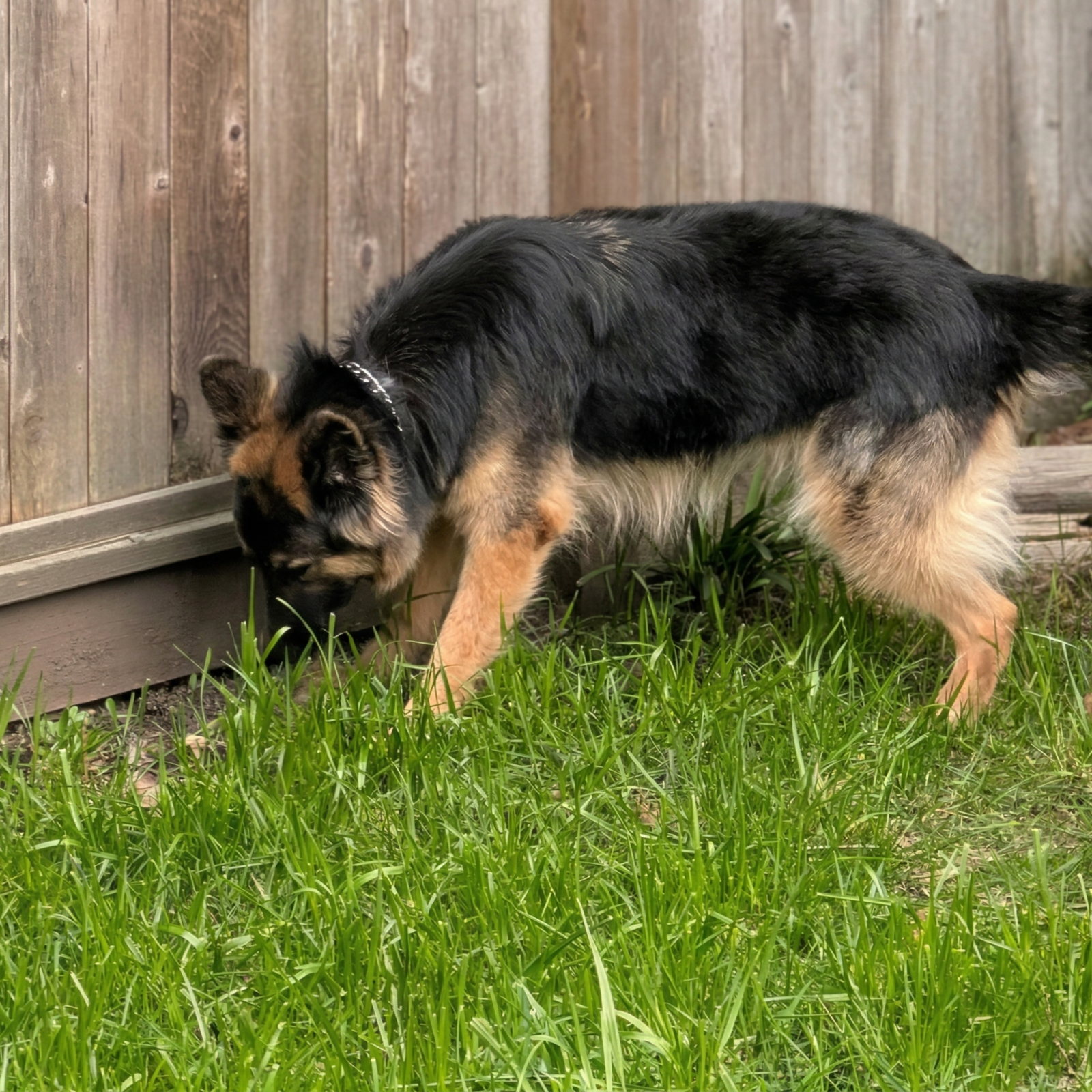
Why Dogs Need to Sniff on Walks
This guide is part of the Training & Behaviour Hub, where we break down how long-haired German Shepherds think, assess, and respond.
Most people think a walk is about movement — but for dogs, it’s about scent.
For a long-haired German Shepherd, it’s not.
It’s about information.
If you rush that process, you’re not exercising your dog — you’re frustrating it.
And with this breed, frustration doesn’t disappear. It builds.
A Shepherd’s Nose Is Not a Side Feature
Dogs experience the world primarily through scent.
A dog’s nose is built for this.
Where humans have around 5 million scent receptors, dogs can have up to 300 million — with a portion of their brain dedicated specifically to processing smell.
For a long-haired German Shepherd, that ability isn’t just strong — it’s foundational to how they interpret the world around them.
Long-haired German Shepherds take that to another level.
They’re not just smelling — they’re analysing:
- who has been there
- how recently
- what state that animal or person was in
- whether anything has changed since the last time
It’s not random behaviour.
It’s situational awareness.
Sniffing Builds Stability
When a Shepherd is allowed to process its environment through scent, something important happens:
- stress drops
- confidence increases
- decision-making improves
- reactivity decreases
This is especially critical for rescue dogs.
Sniffing gives them context — and context reduces uncertainty.
Without that context, the world feels unpredictable.
And unpredictable environments create unstable behaviour.
Why Rushing the Walk Backfires
A fast, controlled walk might look disciplined.
For a long-haired German Shepherd, it often creates the opposite result.
If the dog is constantly pulled away from scent work:
- mental energy builds with nowhere to go
- frustration increases
- focus deteriorates
- reactivity becomes more likely
You end up with a dog that looks physically exercised — but is mentally unresolved.
Structure Still Matters
Letting your dog sniff does not mean letting your dog do whatever it wants.
There is a difference between:
- structured exploration
- chaotic wandering
A balanced walk includes both:
- clear direction from the handler
- intentional moments where the dog is allowed to investigate
This creates clarity — and clarity creates calm.
What This Means for You
If you want a stable, thinking dog, you have to respect how that dog gathers information.
With a long-haired German Shepherd, it starts with the nose.
Let them read the environment.
Let them process what’s around them.
You’re not losing control.
You’re giving them the information they need to stay balanced within it.